Download Mendeley
Unique features of EIGHT fold-Proteins with the most complex 8 3 knotted topology.
Mozajew, M., Sikora, M., Fortunka, M., Perlinska, A.P., Kluza, A., Niewieczerzal, S., da Silva, F.B., Lukaszewicz, M., Sikorska, J.A., Mikulska, L.J., Jackson, S.E., Sulkowska, J.I.(2026) Proc Natl Acad Sci U S A 123: e2523017123-e2523017123
- PubMed: 42896058 Search on PubMedSearch on PubMed Central
- DOI: https://doi.org/10.1073/pnas.2523017123
- Primary Citation Related Structures:
32UY, 9RH0, 9TMH - PubMed Abstract:
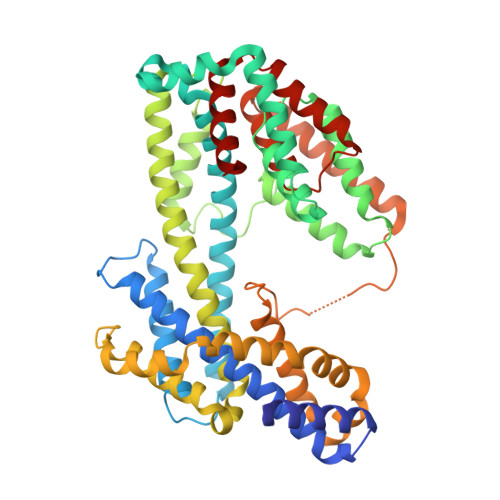
Herein, we present three crystal structures of the most complex knotted protein to date, an [Formula: see text] knot with eight crossings, which belongs to a clasp knot family. The fold of this protein is also unique, and we call it the EIGHT fold (Extraordinarily Intricate Globular Helical Tangled fold). The [Formula: see text] knot is found only in a certain group of bacteria, where it is strictly conserved, despite sequence identities as low as 10%. The [Formula: see text] structure shows a high level of internal symmetry, with structurally analogous halves. It is possible that the EIGHT fold evolved from a single unknotted "half" that duplicated and formed a complex protein. Based on an in vitro study of three selected [Formula: see text] proteins, we estimated their thermal and thermodynamic stability, and showed that they follow a two-state unfolding model under equilibrium conditions and their refolding occurs to a compact, nonnative state. Unfolding kinetics of [Formula: see text] knotted proteins reveal a complex, multiphase process spanning milliseconds to days. Six kinetic phases were resolved using stopped-flow fluorescence and far-ultraviolet absorbance circular dichroism spectroscopy, highlighting both rapid early events and slower rearrangements in secondary and tertiary structures. Finally, with a structure-based model, we showed that proteins with an [Formula: see text] knot can self-tie through a [Formula: see text] knotted intermediate state. They can also self-untie, albeit via an additional intermediate knot such as [Formula: see text]. Nevertheless, these proteins do not seem to fit with current folding theories known to date and require the development of a new approach.
- Centre of New Technologies, University of Warsaw, Banacha 2C St., Warszawa 02-097, Poland.
Organizational Affiliation: