9T6U | pdb_00009t6u

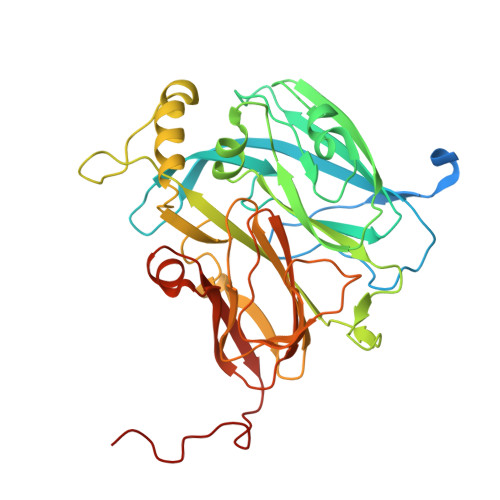
Higher-dose (1332 kGy) structure of copper-containing nitrite reductase from Achromobacter cycloclastes at cryogenic temperature


Experimental Data Snapshot

  • Method: X-RAY DIFFRACTION
  • Resolution: 1.50 Å
  • R-Value Free: 
    0.188 (Depositor), 0.188 (DCC) 
  • R-Value Work: 
    0.153 (Depositor), 0.154 (DCC) 

Starting Model: experimental
View more details

wwPDB Validation   3D Report Full Report


This is version 1.0 of the entry. See complete history


Literature

Coupled on-line in crystallo UV-Vis absorption spectroscopy and X-ray crystallography to compare specific radiation damage in metal-containing proteins at room versus cryogenic temperature.

Caramello, N.Rose, S.L.Mathieu, E.Petit, L.Tews, I.Engilberge, S.Royant, A.

(2026) Acta Crystallogr D Struct Biol 

  • DOI: https://doi.org/10.1107/S2059798326000690
  • Primary Citation of Related Structures:  
    9T6O, 9T6P, 9T6Q, 9T6U, 9T6V, 9T6W, 9T6X, 9T6Y

  • PubMed Abstract: 

    Specific radiation damage (SRD) to proteins is a pertinent issue discovered during the development of cryo-crystallography at synchrotrons, often affecting the macromolecular active site and thus complicating the understanding of mechanistic insights from structural analysis. For proteins with a spectroscopic signature in the visible light spectrum, in crystallo UV-Vis absorption spectroscopy has regularly been used to estimate the dose scale of specific damage build-up and to develop diffraction data-collection strategies to mitigate its effects. Using a coupled spectroscopic and crystallographic approach, here we show that for two metal-containing proteins the structural response to X-ray-induced reduction of metals in their active site is markedly different at room temperature than at cryogenic temperature. This suggests that the use of controlled specific radiation damage to mimic and study a physiological redox transition in a metal-containing protein by X-ray crystallography should preferably be performed at room temperature rather than at cryogenic temperature.


  • Organizational Affiliation
    • Université Grenoble Alpes, CNRS, CEA, Institut de Biologie Structurale, 38044 Grenoble, France.

Macromolecules
Find similar proteins by:  (by identity cutoff)  |  3D Structure
Entity ID: 1
MoleculeChains Sequence LengthOrganismDetailsImage
Copper-containing nitrite reductase378Achromobacter cycloclastesMutation(s): 0 
Gene Names: nirK
EC: 1.7.2.1
UniProt
Find proteins for P25006 (Achromobacter cycloclastes)
Explore P25006 
Go to UniProtKB:  P25006
Entity Groups  
Sequence Clusters30% Identity50% Identity70% Identity90% Identity95% Identity100% Identity
UniProt GroupP25006
Sequence Annotations
Expand
  • Reference Sequence
Small Molecules
Ligands 2 Unique
IDChains Name / Formula / InChI Key2D Diagram3D Interactions
SO4
Query on SO4

Download Ideal Coordinates CCD File 
D [auth A]
E [auth A]
F [auth A]
G [auth A]
H [auth A]
D [auth A],
E [auth A],
F [auth A],
G [auth A],
H [auth A],
I [auth A],
J [auth A]
SULFATE ION
O4 S
QAOWNCQODCNURD-UHFFFAOYSA-L
CU (Subject of Investigation/LOI)
Query on CU

Download Ideal Coordinates CCD File 
B [auth A],
C [auth A]
COPPER (II) ION
Cu
JPVYNHNXODAKFH-UHFFFAOYSA-N
Experimental Data & Validation

Experimental Data

  • Method: X-RAY DIFFRACTION
  • Resolution: 1.50 Å
  • R-Value Free:  0.188 (Depositor), 0.188 (DCC) 
  • R-Value Work:  0.153 (Depositor), 0.154 (DCC) 
Space Group: P 21 3
Unit Cell:
Length ( Å )Angle ( ˚ )
a = 95.375α = 90
b = 95.375β = 90
c = 95.375γ = 90
Software Package:
Software NamePurpose
REFMACrefinement
XDSdata reduction
Aimlessdata scaling
REFMACphasing

Structure Validation

View Full Validation Report


Entry History & Funding Information

Deposition Data


Funding OrganizationLocationGrant Number
Agence Nationale de la Recherche (ANR)FranceANR-10-INSB-05-02
Agence Nationale de la Recherche (ANR)FranceANR-10-LABX-49-01

Revision History  (Full details and data files)

  • Version 1.0: 2026-03-04
    Type: Initial release