Download Mendeley
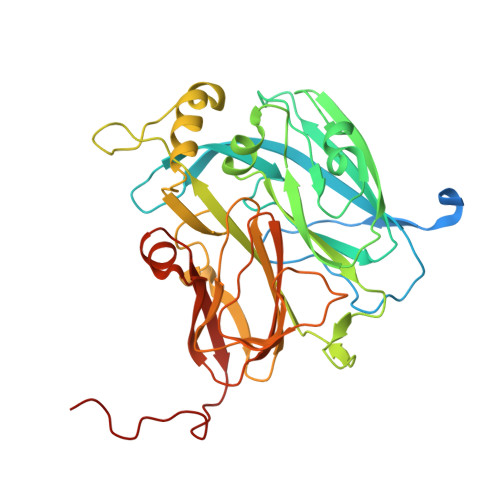
Coupled on-line in crystallo UV-Vis absorption spectroscopy and X-ray crystallography to compare specific radiation damage in metal-containing proteins at room versus cryogenic temperature.
Caramello, N., Rose, S.L., Mathieu, E., Petit, L., Tews, I., Engilberge, S., Royant, A.(2026) Acta Crystallogr D Struct Biol 82: 187-198
- PubMed: 41641581
- DOI: https://doi.org/10.1107/S2059798326000690
- Primary Citation Related Structures:
9T6O, 9T6P, 9T6Q, 9T6U, 9T6V, 9T6W, 9T6X, 9T6Y - PubMed Abstract:
Specific radiation damage (SRD) to proteins is a pertinent issue discovered during the development of cryo-crystallography at synchrotrons, often affecting the macromolecular active site and thus complicating the understanding of mechanistic insights from structural analysis. For proteins with a spectroscopic signature in the visible light spectrum, in crystallo UV-Vis absorption spectroscopy has regularly been used to estimate the dose scale of specific damage build-up and to develop diffraction data-collection strategies to mitigate its effects. Using a coupled spectroscopic and crystallographic approach, here we show that for two metal-containing proteins the structural response to X-ray-induced reduction of metals in their active site is markedly different at room temperature than at cryogenic temperature. This suggests that the use of controlled specific radiation damage to mimic and study a physiological redox transition in a metal-containing protein by X-ray crystallography should preferably be performed at room temperature rather than at cryogenic temperature.
- Université Grenoble Alpes, CNRS, CEA, Institut de Biologie Structurale, 38044 Grenoble, France.
Organizational Affiliation: