Download Mendeley
Allosteric inhibition of human mitochondrial ClpP by hijacking the dordaviprone (ONC201) binding site.
Goncalves, M.M., Uday, A.B., Watson, I.D.G., Chau, A.M., Kalhor-Monfared, S., Wan, B., Kiyota, T., Currie, S.Q.W., Jitkova, Y., Feng, Y., Diamandas, M., Ling, D., Ma, M., Mancini, R.S., Wang, Z., Casas-Selves, M., Joshi, D., Mohammed, M., Subramaniam, R., Fernandes, E.L., Yan, Y., Pomroy, N., Hurren, R., Gronda, M., Velyvis, A., Yudin, A.K., Reed, M.A., Prive, G., Aman, A., Isaac, M., Marcellus, R., Uehling, D., Schimmer, A.D., Zeytuni, N., Vahidi, S.(2026) Nat Commun 17
- PubMed: 42946762 Search on PubMedSearch on PubMed Central
- DOI: https://doi.org/10.1038/s41467-026-78140-5
- Primary Citation Related Structures:
9XYH, 9XYJ - PubMed Abstract:
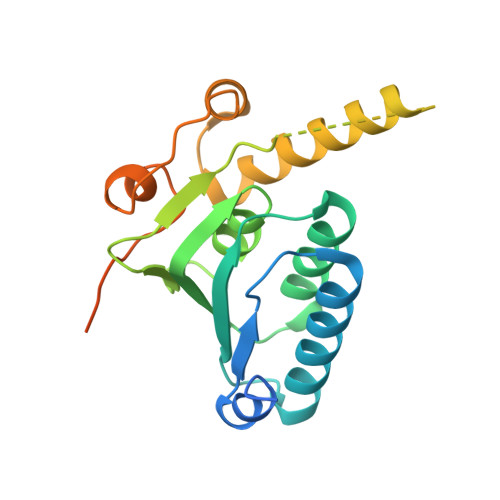
ClpP protease maintains proteostasis in human mitochondria and is overexpressed in cancers such as acute myeloid leukemia (AML). While activators such as dordaviprone (ONC201) have reached the clinic, the development of ClpP inhibitors has been hampered by paradoxical activation upon orthosteric inhibitor binding. Here, we report a series of quinazolinone-based compounds that allosterically inhibit human ClpP with nanomolar potency. Cryo-EM and H/D exchange mass spectrometry reveal that our lead compound binds sub-stoichiometrically to a distal hydrophobic pocket ~30 Å from the active sites, disrupts a conserved inter-subunit cluster, and induces a conformational change that misaligns the catalytic triad, thereby inactivating ClpP. The binding site of our quinazolinone-based inhibitors partially overlaps with that of the activator dordaviprone. In a xenograft mouse model of leukemia, our lead compound significantly reduced tumor burden following short-term oral administration. Our findings identify a regulatory hotspot in human ClpP and a mechanistically distinct inhibition strategy.
- Department of Molecular and Cellular Biology, University of Guelph, Guelph, ON, Canada.
Organizational Affiliation: