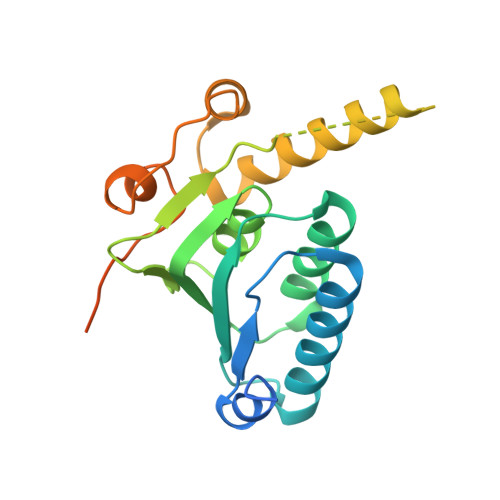
9XYH | pdb_00009xyh

Human mitochondrial ClpP in complex with OICR-18704 in the heptameric state


Experimental Data Snapshot

  • Method: ELECTRON MICROSCOPY
  • Resolution: 3.40 Å
  • Aggregation State: PARTICLE 
  • Reconstruction Method: SINGLE PARTICLE 

wwPDB Validation 3D Report Full Report

Validation slider image for 9XYH

This is version 1.1 of the entry. See complete history. 

Literature

Allosteric inhibition of human mitochondrial ClpP by hijacking the dordaviprone (ONC201) binding site.

Goncalves, M.M., Uday, A.B., Watson, I.D.G., Chau, A.M., Kalhor-Monfared, S., Wan, B., Kiyota, T., Currie, S.Q.W., Jitkova, Y., Feng, Y., Diamandas, M., Ling, D., Ma, M., Mancini, R.S., Wang, Z., Casas-Selves, M., Joshi, D., Mohammed, M., Subramaniam, R., Fernandes, E.L., Yan, Y., Pomroy, N., Hurren, R., Gronda, M., Velyvis, A., Yudin, A.K., Reed, M.A., Prive, G., Aman, A., Isaac, M., Marcellus, R., Uehling, D., Schimmer, A.D., Zeytuni, N., Vahidi, S.

(2026) Nat Commun 17

  • DOI: https://doi.org/10.1038/s41467-026-78140-5
  • Primary Citation Related Structures: 
    9XYH, 9XYJ

  • PubMed Abstract: 

    ClpP protease maintains proteostasis in human mitochondria and is overexpressed in cancers such as acute myeloid leukemia (AML). While activators such as dordaviprone (ONC201) have reached the clinic, the development of ClpP inhibitors has been hampered by paradoxical activation upon orthosteric inhibitor binding. Here, we report a series of quinazolinone-based compounds that allosterically inhibit human ClpP with nanomolar potency. Cryo-EM and H/D exchange mass spectrometry reveal that our lead compound binds sub-stoichiometrically to a distal hydrophobic pocket ~30 Å from the active sites, disrupts a conserved inter-subunit cluster, and induces a conformational change that misaligns the catalytic triad, thereby inactivating ClpP. The binding site of our quinazolinone-based inhibitors partially overlaps with that of the activator dordaviprone. In a xenograft mouse model of leukemia, our lead compound significantly reduced tumor burden following short-term oral administration. Our findings identify a regulatory hotspot in human ClpP and a mechanistically distinct inhibition strategy.


  • Organizational Affiliation: 
    • Department of Molecular and Cellular Biology, University of Guelph, Guelph, ON, Canada.

Macromolecule Content 

  • Total Structure Weight: 170.26 kDa 
  • Atom Count: 9,084 
  • Modeled Residue Count: 1,146 
  • Deposited Residue Count: 1,547 
  • Unique protein chains: 1

Macromolecules

Find similar proteins by:|  3D Structure
Entity ID: 1
MoleculeChains  Sequence LengthOrganismDetailsImage
ATP-dependent Clp protease proteolytic subunit, mitochondrial
A, B, C, D, E
A, B, C, D, E, F, G
221Homo sapiensMutation(s): 0 
Gene Names: CLPP
EC: 3.4.21.92
UniProt & NIH Common Fund Data Resources
Find proteins for Q16740 (Homo sapiens)
Explore Q16740 
Go to UniProtKB:  Q16740
GTEx:  ENSG00000125656 
Entity Groups
Sequence Clusters30% Identity50% Identity70% Identity90% Identity95% Identity100% Identity
UniProt GroupQ16740
Sequence Annotations
Expand
Reference Sequence

Small Molecules

Ligands 1 Unique
IDChains Name / Formula / InChI Key2D Diagram3D Interactions
A1CRQ
(Subject of Investigation/LOI)

Query on A1CRQ


Download:Ideal Coordinates CCD File
H [auth A],
I [auth D]
4-[4-({7-chloro-3-[(1S)-1-cyanoethyl]-4-oxo-3,4-dihydroquinazolin-2-yl}methyl)piperazin-1-yl]-2-(trifluoromethyl)benzonitrile
C24 H20 Cl F3 N6 O
BXKKKAXDFWWIBK-HNNXBMFYSA-N

Experimental Data & Validation

Experimental Data

  • Method: ELECTRON MICROSCOPY
  • Resolution: 3.40 Å
  • Aggregation State: PARTICLE 
  • Reconstruction Method: SINGLE PARTICLE 
EM Software:
TaskSoftware PackageVersion
MODEL REFINEMENTPHENIX1.21.2_5419
RECONSTRUCTIONcryoSPARC

Structure Validation

View Full Validation Report


Entry History 

& Funding Information

Deposition Data


Funding OrganizationLocationGrant Number
Canadian Institutes of Health Research (CIHR)CanadaPJT-191940

Revision History  (Full details and data files)

  • Version 1.0: 2026-10-14
    Type: Initial release
  • Version 1.1: 2026-11-11
    Changes: Data collection, Database references