Download Mendeley
Dynamic metal coordination controls chemoselectivity in a radical halogenase.
Kissman, E.N., Kipouros, I., Slater, J.W., Stone, E.A., Yang, A.Y., Braun, A., Ensberg, A.R., Whitten, A.M., Chatterjee, K., Bogacz, I., Yano, J., Martin Bollinger Jr., J., Chang, M.C.Y.(2025) Nat Chem Biol
- PubMed: 41272319
- DOI: https://doi.org/10.1038/s41589-025-02077-x
- Primary Citation of Related Structures:
9OER, 9OES, 9OET, 9OEU, 9OEV, 9OEW - PubMed Abstract:
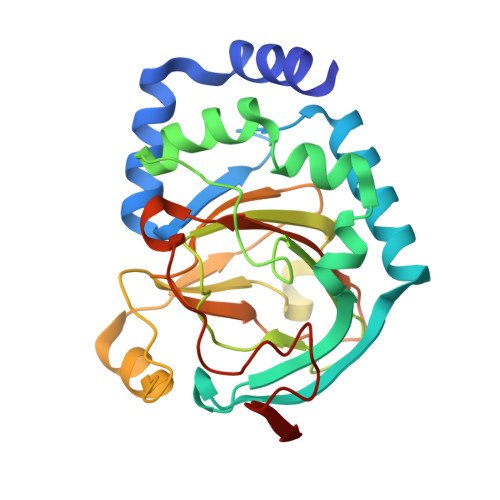
The activation of inert C(sp 3 )-H bonds by nonheme Fe enzymes provides a powerful biocatalytic platform for the chemical synthesis of molecules with increased sp 3 complexity. In this context, Fe II /α-ketoglutarate-dependent radical halogenases are uniquely capable of carrying out transfer of a diverse array of bound anions following C-H activation. Here, we provide experimental evidence that bifurcation of radical rebound after H-atom abstraction can be driven both by the ability of a dynamic metal coordination sphere to reorganize and by a second-sphere hydrogen-bonding network where only two residues are sufficient. In addition, we present crystallographic data supporting the existence of an early peroxyhemiketal intermediate in the O 2 activation pathway of Fe II /α-ketoglutarate-dependent enzymes. These data provide a paradigm for understanding the evolution of catalytic plasticity in these enzymes and yields insight into the design principles by which to expand their reaction scope.
- Department of Chemistry, University of California, Berkeley, CA, USA.
Organizational Affiliation: