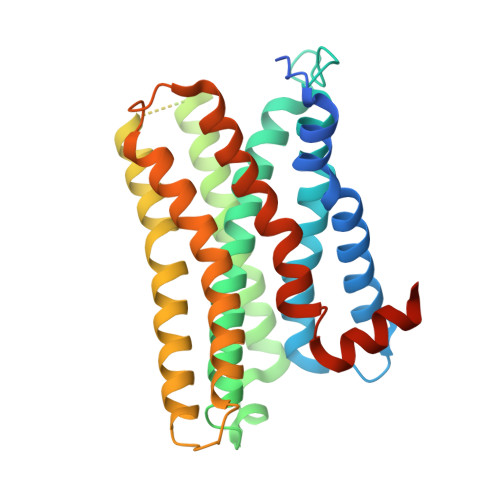
Primary Citation Related Structures: 9LKB, 9LKD, 9WPM
PubMed Abstract:
Smell is one of the fundamental senses mediated by thousands of odorant receptors (ORs). How hydrophobic and volatile odor molecules are recognized by class II ORs remains elusive. Here, we present cryo-electron microscopy (cryo-EM) structures of class II OR Olfr110 complexed with the unsaturated fatty acid metabolite (UFAM) PL45, Gs, and cons-OR5. The structural study revealed an unusually large hydrophobic pocket accommodating PL45 and the endogenous agonist 12(S)-hydroxyeicosapentaenoic acid (12(S)-HEPE). This pocket is decorated with polar residues and aromatic residue arrays, constituting polar networks and π-π interactions with the natural agonist PL45, respectively. Conserved motifs in the type II OR5 subfamily responsible for ligand recognition are characterized. The inward movement of extracellular loop 3 (ECL3) and an unconventional activation mechanism underlie Olfr110 activation. At the G protein interface, Olfr110 displays common and unique interactions. Overall, we revealed the structural basis of odor recognition and the activation mechanism of class II ORs, which may facilitate drug development targeting these receptors.
Organizational Affiliation:
Shandong Provincial Third Hospital, Department of Physiology and Pathophysiology, School of Basic Medical Sciences, Cheeloo College of Medicine, Shandong University, Jinan 250012, China; NHC Key Laboratory of Otorhinolaryngology, Qilu hospital and New Cornerstone Science Laboratory, Advanced Medical Research Institute, Cheeloo College of Medicine, Shandong University, Jinan 250012, China.
Shandong Provincial Third Hospital, Department of Physiology and Pathophysiology, School of Basic Medical Sciences, Cheeloo College of Medicine, Shandong University, Jinan 250012, China; Department of Hepatobiliary Surgery, General Surgery, Qilu Hospital, Cheeloo College of Medicine, Shandong University, Jinan 250012, China.
NHC Key Laboratory of Otorhinolaryngology, Qilu hospital and New Cornerstone Science Laboratory, Advanced Medical Research Institute, Cheeloo College of Medicine, Shandong University, Jinan 250012, China.
iHuman Institute, ShanghaiTech University, Shanghai 201210, China.
Department of Pharmacology, School of Pharmaceutical Sciences, Guangzhou University of Chinese Medicine, Guangzhou 510006, China.
Shandong Provincial Third Hospital, Department of Physiology and Pathophysiology, School of Basic Medical Sciences, Cheeloo College of Medicine, Shandong University, Jinan 250012, China.
Department of Otolaryngology, Songjiang Hospital and Songjiang Research Institute, Ministry of Education Key Laboratory of Children's Environmental Health, Shanghai Key Laboratory of Emotions and Affective Disorders, Department of Anatomy and Physiology, Shanghai Jiao Tong University School of Medicine, Shanghai 201318, China.
School of Pharmacy, Binzhou Medical University, Yantai 264003, China.
College of Pharmacy, Shenzhen Technology University, Shenzhen 518118, China.
Department of Hepatobiliary Surgery, General Surgery, Qilu Hospital, Cheeloo College of Medicine, Shandong University, Jinan 250012, China.
School of Biological Science and Technology, University of Jinan, Jinan, China.
Shandong Provincial Third Hospital, Department of Physiology and Pathophysiology, School of Basic Medical Sciences, Cheeloo College of Medicine, Shandong University, Jinan 250012, China; Department of Neurology, Shandong Provincial Third Hospital, Shandong University, Jinan, China; Shandong Provincial Key Medical and Health Discipline of Neurology, Shandong Provincial Third Hospital, Jinan, China.
Department of Otolaryngology, Shandong Provincial Hospital Affiliated to Shandong First Medical University, Jinan, China; Medical Science and Technology Innovation Center, Shandong First Medical University and Shandong Academy of Medical Sciences, Jinan, China. Electronic address: xiamingsdu@sohu.com.
Department of Otolaryngology, Songjiang Hospital and Songjiang Research Institute, Ministry of Education Key Laboratory of Children's Environmental Health, Shanghai Key Laboratory of Emotions and Affective Disorders, Department of Anatomy and Physiology, Shanghai Jiao Tong University School of Medicine, Shanghai 201318, China. Electronic address: liqian@shsmu.edu.cn.
Shandong Provincial Third Hospital, Department of Physiology and Pathophysiology, School of Basic Medical Sciences, Cheeloo College of Medicine, Shandong University, Jinan 250012, China. Electronic address: yuxiao@sdu.edu.cn.
Shandong Provincial Third Hospital, Department of Physiology and Pathophysiology, School of Basic Medical Sciences, Cheeloo College of Medicine, Shandong University, Jinan 250012, China; NHC Key Laboratory of Otorhinolaryngology, Qilu hospital and New Cornerstone Science Laboratory, Advanced Medical Research Institute, Cheeloo College of Medicine, Shandong University, Jinan 250012, China; State Key Laboratory of Discovery and Utilization of Functional Components in Traditional Chinese Medicine, Shandong University, Jinan 250012, China. Electronic address: yangfan1357@163.com.
Shandong Provincial Third Hospital, Department of Physiology and Pathophysiology, School of Basic Medical Sciences, Cheeloo College of Medicine, Shandong University, Jinan 250012, China; NHC Key Laboratory of Otorhinolaryngology, Qilu hospital and New Cornerstone Science Laboratory, Advanced Medical Research Institute, Cheeloo College of Medicine, Shandong University, Jinan 250012, China; Department of Physiology and Pathophysiology, School of Basic Medical Sciences, State Key Laboratory of Vascular Homeostasis and Remodeling, Beijing Key Laboratory of Cardiovascular Receptors Research, Peking University, Beijing 100191, China. Electronic address: sunjinpeng@sdu.edu.cn.








 Download Mendeley