Download Mendeley
Structural and Pharmacological Basis for the State-Dependent Activation of the Autoinhibited P. aeruginosa ClpP2 Protease.
Zhao, N., Ma, H., Zhu, Z., Fan, D., Dai, D., Mou, X., Zhou, J., Li, Y., Gao, M., Chenghuang, J., Liu, S., Huang, H., Bao, R.(2026) ACS Chem Biol 21: 1383-1396
- PubMed: 42119043 Search on PubMed
- DOI: https://doi.org/10.1021/acschembio.6c00141
- Primary Citation Related Structures:
21KU - PubMed Abstract:
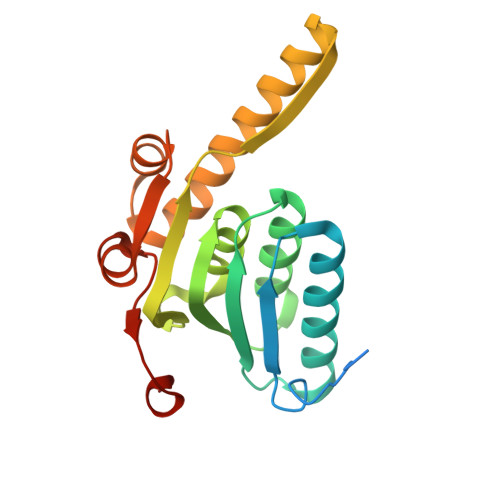
Ubiquitous in biological systems, caseinolytic protease P (ClpP) represents a premier target for antimicrobial and antitumor therapies due to its central role in proteostasis. In Pseudomonas aeruginosa , PaClpP1 and PaClpP2 display distinct oligomeric states and enzymatic properties, yet the molecular basis underlying this divergence remains elusive. Here, by combining biochemical characterization, structural analysis, and molecular dynamics simulations, we identify Arg140 in PaClpP2 as the critical structural determinant governing its autoinhibited state. Mutation of this residue to alanine (R140A) relieves steric constraints, promoting the extension of the handle domain and conferring a robust proteolytic activity. Enzymatic assays further reveal that bortezomib and Z-Ile-Leu (ZIL) exert opposing, conformation-dependent effects on PaClpP. Molecular docking suggests that steric hindrance by R140 prevents canonical binding and induces a conformational switch, thereby activating the enzyme. Collectively, our findings establish the handle domain as a pivotal conformational switch, offering a structural foundation for the design of isoform-specific modulators.
- Center of Infectious Diseases, Division of Infectious Diseases in State Key Laboratory of Biotherapy, West China Hospital Sichuan University, Chengdu610041, China.
Organizational Affiliation: