Download Mendeley
Cryo-EM and biochemical characterization of a BRAF/CRAF heterodimer shows that the NtA motif negative charge is dispensable for RAF activation.
Ha, B.H., Tkacik, E., Gazgalis, D., Kang, H., Jang, D.M., Chakraborty, S., Jeon, H., Eck, M.J.(2026) Cell Rep 45: 118165-118165
- PubMed: 42925506 Search on PubMed
- DOI: https://doi.org/10.1016/j.celrep.2026.118165
- Primary Citation Related Structures:
13DU, 13DV - PubMed Abstract:
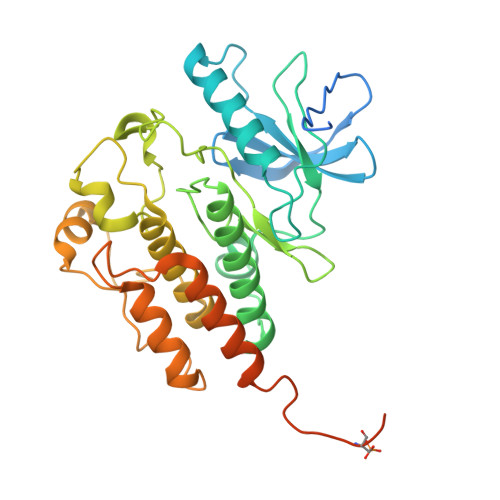
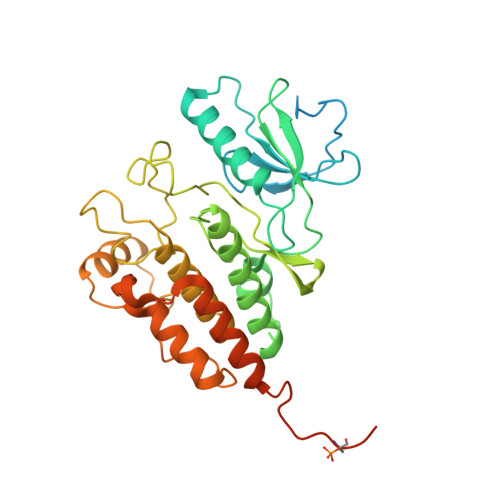
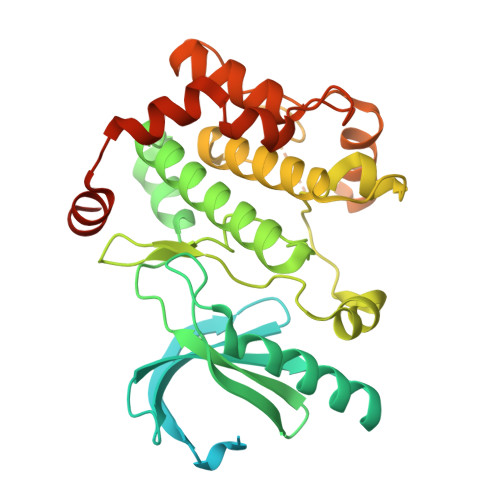
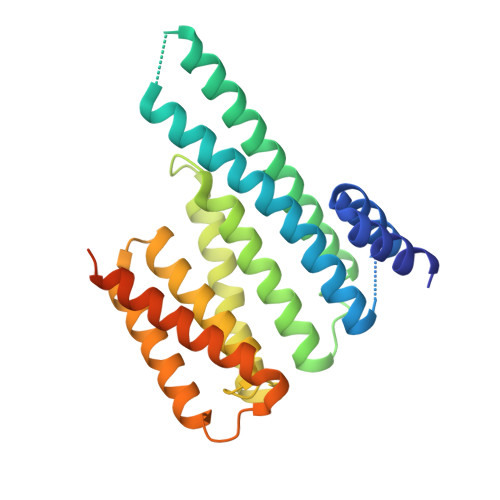
Upon RAS-driven membrane recruitment, RAF kinases ARAF, BRAF, and CRAF are activated through homo- or heterodimerization to initiate MAP kinase signaling. Although RAF heterodimers drive physiologic and oncogenic signaling, they remain little studied structurally and biochemically. Here, we report the preparation, biochemical characterization, and cryo-EM structures of 14-3-3-bound BRAF/CRAF heterodimer complexes. The heterodimer exhibits kinetic parameters and RAF inhibitor sensitivities intermediate between, or closely matching, BRAF and CRAF homodimers. Cryo-EM structures reveal an organization identical to RAF homodimers, with an asymmetric interaction unique to the MEK1-bound structure in which the BRAF acidic NtA motif engages the CRAF RKTR motif. Mutagenesis reveals that replacing the acidic NtA sequence with basic RARA yields active dimers, showing that negative charge is dispensable for activity. Collectively, our findings suggest the NtA charge state influences RAF activity through effects on local backbone dynamics and inactive-state stability, rather than via stereospecific recognition across the dimer interface.
- Department of Cancer Biology, Dana-Farber Cancer Institute, Boston, MA 02215, USA; Department of Biological Chemistry and Molecular Pharmacology, Harvard Medical School, Boston, MA 02115, USA.
Organizational Affiliation: