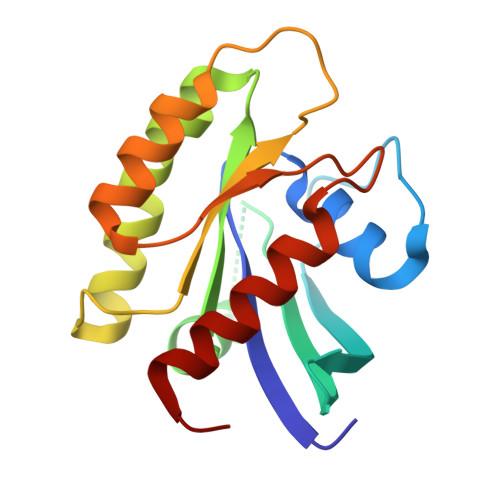
11FB | pdb_000011fb

Structure of GDP-bound KRAS-G12C/Y96C, a Switch-II Pocket Inhibitor Resistance Mutant


Experimental Data Snapshot

  • Method: X-RAY DIFFRACTION
  • Resolution: 1.50 Å
  • R-Value Free: 
    0.200 (Depositor), 0.200 (DCC) 
  • R-Value Work: 
    0.177 (Depositor), 0.177 (DCC) 
  • R-Value Observed: 
    0.178 (Depositor) 

Starting Model: experimental
View more details

wwPDB Validation 3D Report Full Report

Validation slider image for 11FB

Ligand Structure Quality Assessment 


This is version 1.1 of the entry. See complete history. 

Literature

Structural mechanisms underlying resistance to Switch-II pocket inhibitors in KRAS.

Whitley, M.J., Dyba, M., Chakrabarti, M., Smith, B.P., Chan, A.H., Denson, J.P., Messing, S.A., Lin, K., Cornilescu, G., Balius, T.E., Nissley, D.V., McCormick, F., Maciag, A.E., Simanshu, D.K.

(2026) Nat Commun 17

  • DOI: https://doi.org/10.1038/s41467-026-78133-4
  • Primary Citation Related Structures: 
    11ES, 11FB, 11FL, 11FT, 11FU, 11GH

  • PubMed Abstract: 

    Direct targeting of KRAS through the Switch-II pocket is an effective therapeutic strategy, but acquired resistance limits clinical benefit. We examine clinically observed resistance mutations (R68S, H95Q, Y96C, Y96D and Q99L) arising during KRAS G12C inhibitor therapy using biochemical, structural, computational and cellular approaches. Covalent and noncovalent binding measurements reveal mutation- and inhibitor-specific reductions in drug engagement across inhibitor classes. Structural analyses identify two principal resistance mechanisms: Type I, involving loss of key inhibitor contacts, and Type II, involving stabilization of pocket-occluding Switch-II conformations. Y96D exhibits both mechanisms through nucleotide-dependent non-native intramolecular interactions, whereas R68S primarily exhibits Type I resistance with modest Type II effects on pocket architecture and Switch-region dynamics. Y96C, H95Q and Q99L predominantly exhibit Type I resistance. All mutants retain RAF1 binding, whereas PI3Kα binding is selectively reduced by R68S and Q99L. Together, these findings provide structural insights for understanding on-target resistance to Switch-II pocket inhibitors.


  • Organizational Affiliation: 
    • NCI RAS Initiative, Cancer Research Technology Program, Frederick National Laboratory for Cancer Research, Frederick, MD, USA.

Macromolecule Content 

  • Total Structure Weight: 19.89 kDa 
  • Atom Count: 1,573 
  • Modeled Residue Count: 166 
  • Deposited Residue Count: 170 
  • Unique protein chains: 1

Macromolecules

Find similar proteins by:|  3D Structure
Entity ID: 1
MoleculeChains  Sequence LengthOrganismDetailsImage
GTPase KRas170Homo sapiensMutation(s): 3 
Gene Names: KRAS, KRAS2, RASK2
EC: 3.6.5.2
UniProt & NIH Common Fund Data Resources
Find proteins for P01116 (Homo sapiens)
Explore P01116 
Go to UniProtKB:  P01116
GTEx:  ENSG00000133703 
Entity Groups
Sequence Clusters30% Identity50% Identity70% Identity90% Identity95% Identity100% Identity
UniProt GroupP01116
Sequence Annotations
Expand
Reference Sequence

Experimental Data & Validation

Experimental Data

  • Method: X-RAY DIFFRACTION
  • Resolution: 1.50 Å
  • R-Value Free:  0.200 (Depositor), 0.200 (DCC) 
  • R-Value Work:  0.177 (Depositor), 0.177 (DCC) 
  • R-Value Observed: 0.178 (Depositor) 
Space Group: H 3 2
Unit Cell:
Length ( Å )Angle ( ˚ )
a = 92.837α = 90
b = 92.837β = 90
c = 119.185γ = 120
Software Package:
Software NamePurpose
XDSdata reduction
XDSdata scaling
MoRDaphasing
PHENIXrefinement
PDB_EXTRACTdata extraction

Structure Validation

View Full Validation Report


Ligand Structure Quality Assessment 


Entry History 

& Funding Information

Deposition Data


Funding OrganizationLocationGrant Number
National Institutes of Health/National Cancer Institute (NIH/NCI)United States75N91019D00024

Revision History  (Full details and data files)

  • Version 1.0: 2026-10-07
    Type: Initial release
  • Version 1.1: 2026-11-11
    Changes: Database references