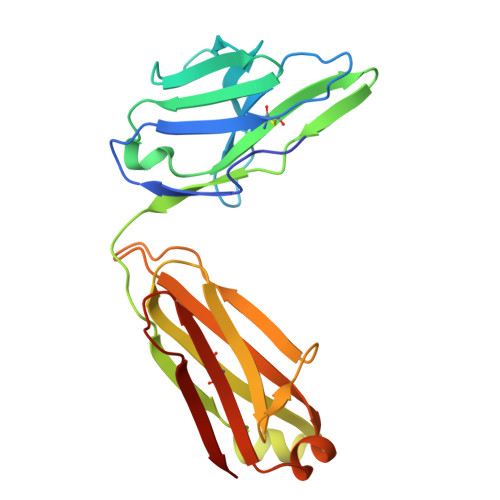
10NE | pdb_000010ne

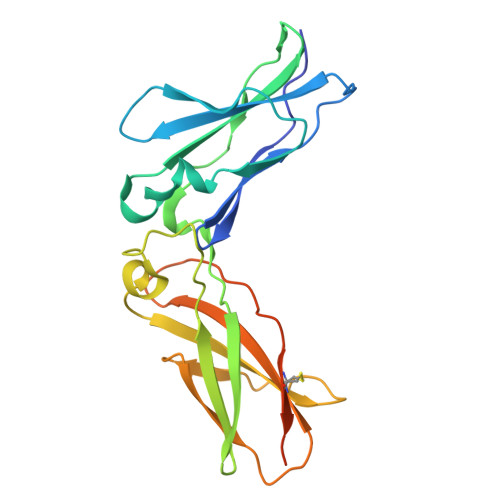
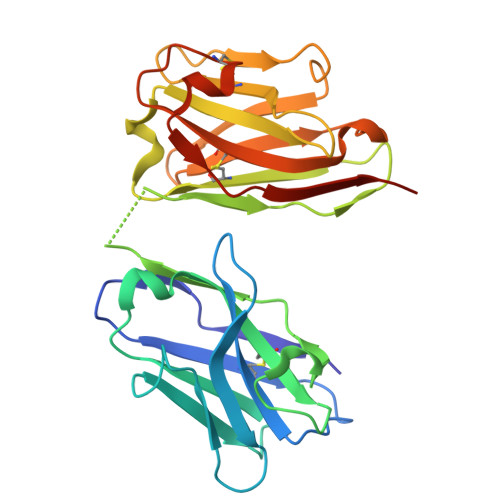
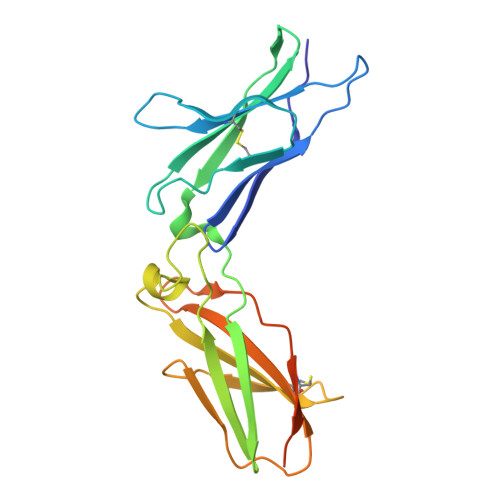
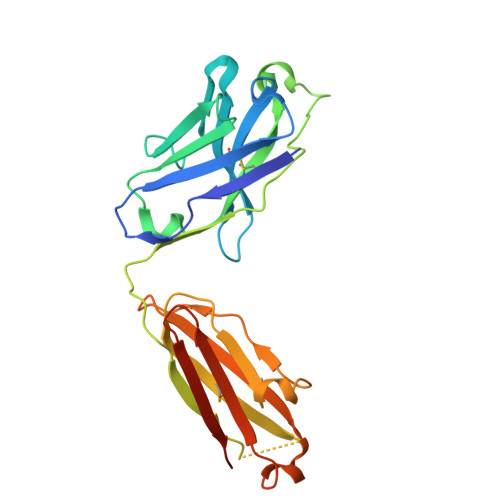
Cryo-EM structure of human IL-10RA and IL-10RB in complex with tandem VHHs E07-A05


Experimental Data Snapshot

  • Method: ELECTRON MICROSCOPY
  • Resolution: 3.14 Å
  • Aggregation State: PARTICLE 
  • Reconstruction Method: SINGLE PARTICLE 

Starting Models: experimental
View more details

wwPDB Validation 3D Report Full Report

Validation slider image for 10NE

This is version 1.1 of the entry. See complete history. 

Literature

Engineered TYK2 dependence enables myeloid-selective IL-10 receptor agonism.

Canaria, D.A., Nguyen, T.T.T., Huang, H., Xu, H., Yue, L., Fu, Y., Truong, H., Patel, K., Xing, W., Ravichandar, J.D., Xing, C., Martin, A.L., Delidakis, G., Wong, S., Pae, A., Yu, Y., Macdonald, R., Huang, Z., Main, M.C., Rodriguez, A., Lin, X., Mouchess, M.L., Hung, M., McGlinchey, E.M., Chen, L., Schirle Oakdale, N., Carr, B., Koleske, M.L., Lee, C.V., Chen, C., Yi, T.

(2026) Nature 

  • DOI: https://doi.org/10.1038/s41586-026-11176-1
  • Primary Citation Related Structures: 
    10ND, 10NE

  • PubMed Abstract: 

    Interleukin-10 (IL-10) is a central anti-inflammatory cytokine that suppresses immune responses in myeloid cells but can also activate T cells, limiting its therapeutic use in chronic inflammatory diseases owing to narrow efficacy windows and dose-limiting toxicities 1-5 . Here we show that myeloid and T cells differ in their dependence on JAK-family kinase pairing for IL-10 signalling and function. We took advantage of this differential kinase dependence to engineer a tetravalent nanobody-based myeloid-selective IL-10 receptor agonist (msIL-10R agonist) that fully recapitulates IL-10's potent suppression of monocytes, macrophages and dendritic cells while avoiding stimulation of T cells. Cryo-electron microscopy structural analysis reveals a distinct receptor cross-linking geometry of the msIL-10R agonist compared with native IL-10 family cytokines. This tetravalent architecture renders signalling strictly TYK2-dependent and highly sensitive to IL-10Rα and IL-10Rβ receptor abundance, thereby conferring selective activity in myeloid cells. This msIL-10R agonist reduces inflammation in humanized mouse models of lipopolysaccharide challenge, delayed-type hypersensitivity and colitis. A humanized version exhibits IgG-like pharmacokinetics, sustained receptor occupancy and durable myeloid suppression up to 30 days without T cell activation or haematological toxicities in non-human primates. These findings establish a geometry-based strategy for achieving cell-type-selective cytokine signalling and identify the msIL-10R agonist as a therapeutic candidate for myeloid-driven inflammatory diseases, including inflammatory bowel diseases.


  • Organizational Affiliation: 
    • Postdoctoral Program, Gilead Sciences, Foster City, CA, USA.

Macromolecule Content 

  • Total Structure Weight: 127.75 kDa 
  • Atom Count: 8,358 
  • Modeled Residue Count: 1,071 
  • Deposited Residue Count: 1,153 
  • Unique protein chains: 5

Macromolecules

Find similar proteins by:|  3D Structure
Entity ID: 1
MoleculeChains  Sequence LengthOrganismDetailsImage
Interleukin-10 receptor subunit alpha227Homo sapiensMutation(s): 0 
Gene Names: IL10RA, IL10R
UniProt & NIH Common Fund Data Resources
Find proteins for Q13651 (Homo sapiens)
Explore Q13651 
Go to UniProtKB:  Q13651
PHAROS:  Q13651
GTEx:  ENSG00000110324 
Entity Groups
Sequence Clusters30% Identity50% Identity70% Identity90% Identity95% Identity100% Identity
UniProt GroupQ13651
Sequence Annotations
Expand
Reference Sequence
Find similar proteins by:|  3D Structure
Entity ID: 2
MoleculeChains  Sequence LengthOrganismDetailsImage
tandem VHHs E07-A05258synthetic constructMutation(s): 0 
Entity Groups
Sequence Clusters30% Identity50% Identity70% Identity90% Identity95% Identity100% Identity
Sequence Annotations
Expand
Reference Sequence
Find similar proteins by:|  3D Structure
Entity ID: 3
MoleculeChains  Sequence LengthOrganismDetailsImage
Interleukin-10 receptor subunit beta214Homo sapiensMutation(s): 0 
Gene Names: IL10RB, CRFB4, D21S58, D21S66
UniProt & NIH Common Fund Data Resources
Find proteins for Q08334 (Homo sapiens)
Explore Q08334 
Go to UniProtKB:  Q08334
PHAROS:  Q08334
GTEx:  ENSG00000243646 
Entity Groups
Sequence Clusters30% Identity50% Identity70% Identity90% Identity95% Identity100% Identity
UniProt GroupQ08334
Sequence Annotations
Expand
Reference Sequence
Find similar proteins by:|  3D Structure
Entity ID: 4
MoleculeChains  Sequence LengthOrganismDetailsImage
Fab Heavy ChainD [auth H]239synthetic constructMutation(s): 0 
Entity Groups
Sequence Clusters30% Identity50% Identity70% Identity90% Identity95% Identity100% Identity
Glycosylation
Glycosylation Sites: 1
Sequence Annotations
Expand
Reference Sequence
Find similar proteins by:|  3D Structure
Entity ID: 5
MoleculeChains  Sequence LengthOrganismDetailsImage
Fab Light ChainE [auth L]215synthetic constructMutation(s): 0 
Entity Groups
Sequence Clusters30% Identity50% Identity70% Identity90% Identity95% Identity100% Identity
Sequence Annotations
Expand
Reference Sequence

Small Molecules

Ligands 1 Unique
IDChains Name / Formula / InChI Key2D Diagram3D Interactions
NAG

Query on NAG


Download:Ideal Coordinates CCD File
F [auth H]2-acetamido-2-deoxy-beta-D-glucopyranose
C8 H15 N O6
OVRNDRQMDRJTHS-FMDGEEDCSA-N

Experimental Data & Validation

Experimental Data

  • Method: ELECTRON MICROSCOPY
  • Resolution: 3.14 Å
  • Aggregation State: PARTICLE 
  • Reconstruction Method: SINGLE PARTICLE 
EM Software:
TaskSoftware PackageVersion
RECONSTRUCTIONcryoSPARC
MODEL REFINEMENTPHENIX1.21.2_5419

Structure Validation

View Full Validation Report


Entry History 

& Funding Information

Deposition Data

  • Released Date: 2026-10-21 
  • Deposition Author(s): Xu, H.

Funding OrganizationLocationGrant Number
Other private--

Revision History  (Full details and data files)

  • Version 1.0: 2026-10-21
    Type: Initial release
  • Version 1.1: 2026-10-28
    Changes: Data collection, Database references